


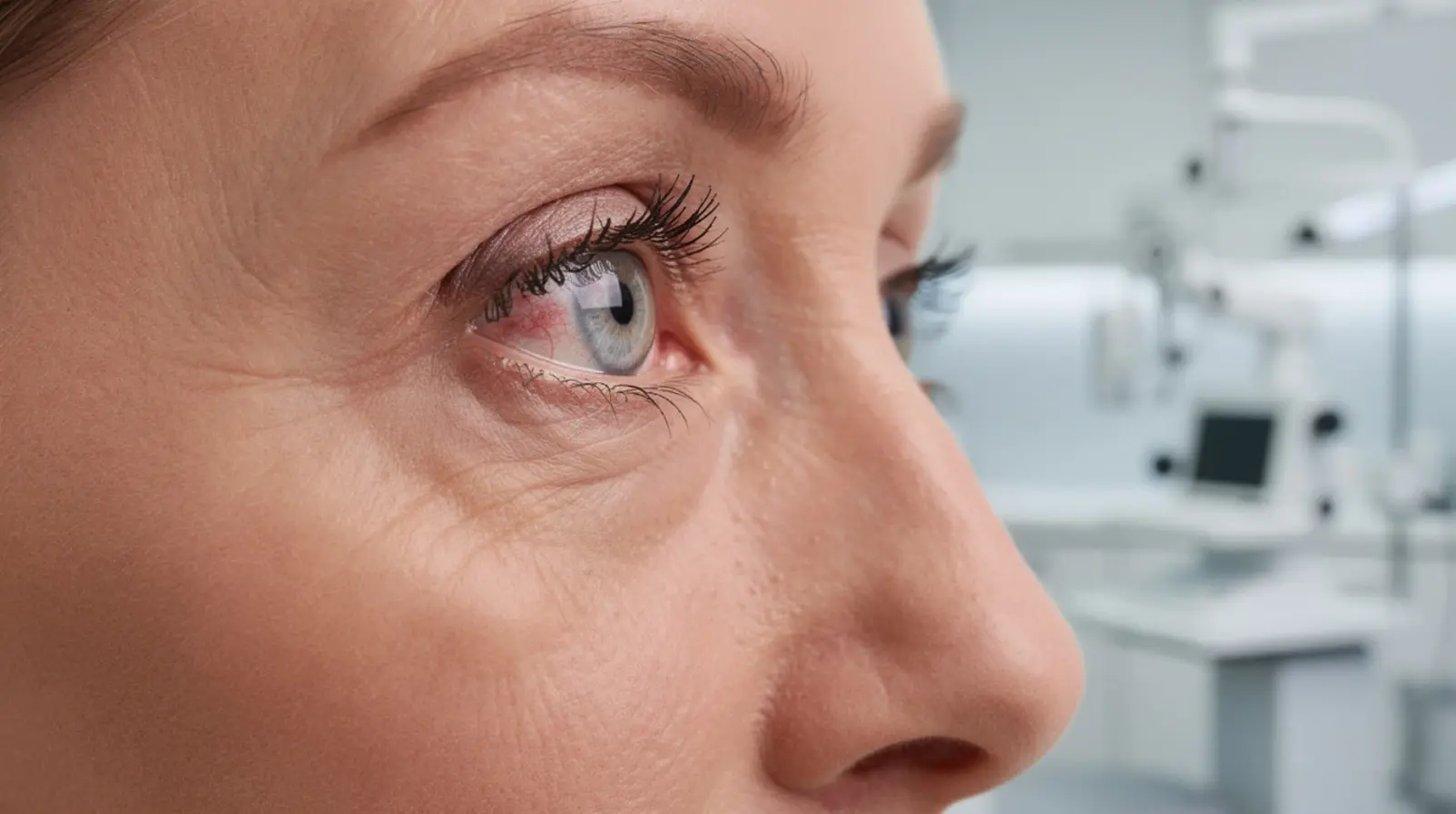
12 May Your eyes are dry and eye drops aren’t helping?
Article summary
You apply artificial tears several times a day, you switch brands, you try gels — and yet your eyes remain irritated, burning, and tired. This frustration is shared by many patients. The reason is often straightforward: lubricating eye drops treat a symptom, not the cause. In the vast majority of cases, dry eyes that don’t respond to eye drops conceal a dysfunction of the Meibomian glands, an anatomical eyelid problem, or chronic inflammation that no drop alone will resolve. This article helps you identify what is truly blocking your visual comfort and what solutions are available today in Switzerland.
Why your eye drops are no longer enough
Standard artificial tears were designed to compensate for a lack of water in the tear film. Yet studies show that 86% of dry eye cases are evaporative in nature, linked to Meibomian gland dysfunction (MGD) — the small glands embedded within your eyelids that secrete the oily layer preventing tear evaporation. In other words, for most patients, the problem is not the volume of tears but their quality.
Without a good-quality lipid layer, your tears — whether natural or artificial — evaporate faster than the drop you just instilled. This is why you feel the need to reapply every hour, sometimes every twenty minutes.
Another aggravating factor is frequently overlooked: the preservatives found in multi-dose bottles, particularly benzalkonium chloride. When used long-term, they disrupt the tear film and sustain low-grade corneal inflammation. Switching to preservative-free formulas in single-dose vials improves tear film stability in chronic users. The more eye drops containing preservatives you instil, the more entrenched this vicious cycle becomes.
Beyond artificial tears, new approaches such as the benefits of ocular photobiomodulation target the cause of evaporation rather than the symptom.
A few signs should alert you:
- You need to apply drops more than four to five times a day
- Relief lasts less than one hour
- Your eyes have become redder since you started using artificial tears
- You have changed brands several times without lasting improvement
The real causes of treatment-resistant dry eye
When dry eye does not resolve, there is almost always an underlying cause that has not been identified. A specialist assessment evaluates both tear production and tear evaporation — two mechanisms that require different treatments.
Meibomian gland dysfunction
This is the primary cause. Among patients with severe dry eye, 80% have MGD confirmed by meibography, an imaging examination that visualises the condition of the glands within the eyelid tissue. These glands may be blocked, atrophied, or producing excessively thick secretions. Without targeted treatment, the situation progressively deteriorates.
Anatomical eyelid factors
Your eyelids distribute the tear film with each blink. Excessive laxity, ectropion (eyelid turning outward), entropion (eyelid turning inward), or abnormal eyelid tension alter tear distribution and accelerate evaporation. These anatomical factors are frequently overlooked during a brief examination.
Environmental, hormonal, and medication-related causes
Prolonged screen exposure reduces blink frequency by half. Air conditioning, heating, contact lens wear, and dry air all amplify evaporation. Menopause alters the composition of Meibomian secretions. Many common medications (antihistamines, antidepressants, beta-blockers, hormonal treatments) also dry out mucous membranes. Certain systemic inflammatory conditions such as Sjögren’s syndrome — an autoimmune disease affecting the lacrimal and salivary glands — should be investigated when dry eye is accompanied by dry mouth or joint pain.
Signs that should prompt you to see a specialist
Temporary discomfort can be managed with a few drops. Dry eye that does not resolve must be properly assessed. The following signs justify a specialist consultation:
- Persistent burning, gritty, or foreign body sensation despite three months of regular instillation
- Vision that fluctuates throughout the day and briefly improves with blinking
- Red or sticky eyelids on waking, recurrent chalazia and associated eyelid conditions
- Paradoxical tearing: your eyes water even though they are dry, as a reflex response to irritation
- Increasing intolerance to contact lenses or eye make-up
- Abnormal visual fatigue at the end of the day, difficulty reading or driving at night
A specialist assessment goes well beyond a simple eye examination. It includes a slit-lamp examination with staining to evaluate the condition of the cornea and conjunctiva, a Schirmer test measuring aqueous production, tear break-up time (TBUT), and meibography to visualise the state of the Meibomian glands. These tests allow precise differentiation between aqueous-deficient and evaporative dry eye, and enable treatment to be tailored accordingly.
Treatments that work when eye drops are no longer enough
When artificial tears are insufficient, there is a logical therapeutic progression, from the simplest to the most advanced approaches.
Eyelid hygiene and thermal therapies
The American Academy of Ophthalmology recommends eyelid hygiene and thermal therapies as first-line treatment in patients who do not respond to lubricants. Daily warm compresses combined with eyelid massage allow 80% of patients unresponsive to artificial tears to experience improvement in Meibomian gland function. In the clinic, controlled thermotherapy devices go further and reduce the OSDI score (dry eye questionnaire) by 45%, compared with 15% with eye drops alone.
Intense pulsed light and photobiomodulation
For moderate to severe Meibomian gland dysfunction, European scientific societies recommend intense pulsed light (IPL) and LED photobiomodulation as second-line treatments. IPL works by liquefying obstructed secretions and reducing eyelid inflammation. Photobiomodulation stimulates the cellular activity of the glands. Dr Bela offers at his Geneva practice a comprehensive dry eye assessment as well as IPL treatment for dry eye syndrome, delivered over several sessions spaced according to a validated protocol.
Surgical correction of eyelid abnormalities
When eyelid anatomy is aggravating evaporation — marked laxity, ectropion, entropion, poor nocturnal closure — no eye drop or IPL treatment will provide a lasting solution. Functional blepharoplasty repositions the eyelid, restores proper closure, and improves tear film distribution. This targeted surgery is an area of expertise for Dr Bela, who assesses each indication on a case-by-case basis.
What you can do starting today
Even before your next appointment, certain measures can have a real impact on your comfort. Apply them consistently for six to eight weeks before concluding that they are ineffective.
- Switch to preservative-free eye drops in single-dose vials. This is the simplest change and often the most beneficial.
- Apply a warm compress for 10 minutes every evening over closed eyelids, followed by a gentle massage from the eyelid margin toward the base of the lashes. Heat liquefies the secretions; massage expels them.
- Follow the 20-20-20 rule when using screens: every 20 minutes, look at an object 6 metres away for 20 seconds. Blink deliberately several times.
- Humidify indoor air, especially in winter, and avoid direct airflow on your face (fans, car air conditioning, hair dryers).
- Enrich your diet with omega-3 fatty acids (oily fish, flaxseeds, walnuts). These fatty acids improve the quality of Meibomian secretions.
- Keep a symptom diary: severity, time of day, aggravating factors. This information is invaluable during your assessment.
If no improvement appears after six to eight weeks of these measures consistently applied, a specialist assessment is recommended to identify the true underlying cause and guide you toward appropriate treatment. Chronic dry eye is an inflammatory disease that worsens over time; the earlier it is managed, the better the outcomes.